






Japan Atomic Energy Agency
Accelerating the deployment of Japan’s HTGR technology through collaboration with the UK
―MoC signed towards the deployment of HTGRs in the UK―
- JAEA, United Kingdom National Nuclear Laboratory (UKNNL) and Rolls-Royce have signed two Memorandums of Cooperation (MoC) on HTGR technology and HTGR fuel technology.
- The participation of Rolls-Royce, aiming to construct HTGRs in the UK, in the collaboration between JAEA and UKNNL will define a clearer pathway towards the practical application of Japan’s HTGR technology and accelerate its deployment.
- With a view to achieving carbon neutrality by 2050, JAEA aims to accelerate the early deployment of HTGRs by advancing the development of HTGR, heat utilisation technologies, and HTGR fuel technology, as well as studies on economic viability, supply‑chain development, and human‑resource development, in collaboration with Rolls‑Royce through UKNNL.
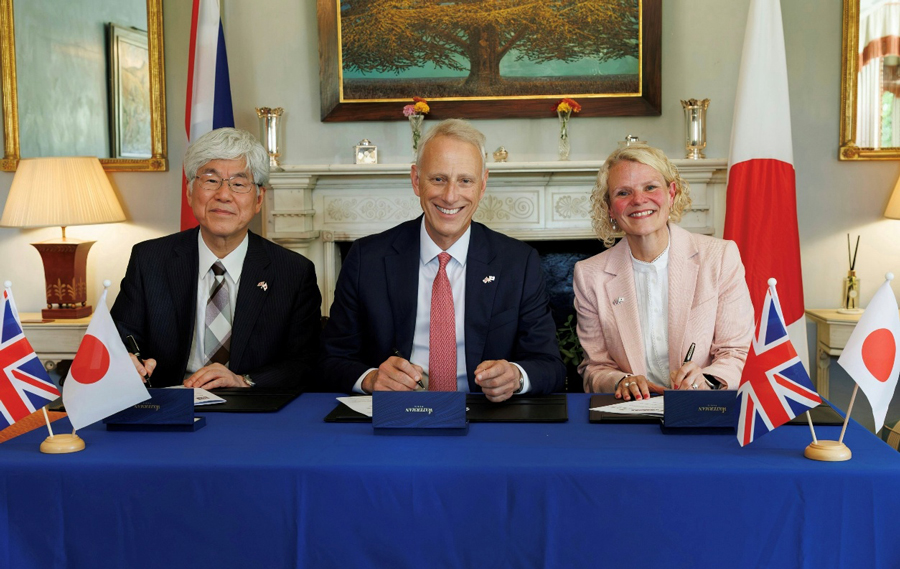
From left: Koguchi President, Chris Cholerton Group President (Rolls-Royce), Julianne Antrobus CEO (UKNNL)
At the signing of two Memorandums of Cooperation (MoC) by JAEA, Rolls-Royce, and the United Kingdom National Nuclear Laboratory (UKNNL), held prior to the formal signing. The formal signing ceremony took place at 10 Downing Street on June 14 (local time), in conjunction with Prime Minister Sanae Takaichi’s visit to the UK.
The UK Government has set a legal target to achieve net zero emissions by 2050 and has identified Advanced Modular Reactor (AMR), specifically HTGRs, as a means to decarbonise industry. Since September 2022, it has been promoting HTGR development through the Advanced Modular Reactor Research, Development and Demonstration (AMR RD&D) Programme, comprising Phase A (pre-FEED), Phase B (FEED), and Phase C (Permissioning, Construction, Detailed Engineering & Operation).
JAEA and UKNNL were selected by the Department for Energy Security and Net Zero (DESNZ) as contractors for the AMR RD&D Programme (Phase A and Phase B) and the AMR Fuel Development Programme (Step 1). They carried out the relevant technological development and completed these programmes.
The UK Government has since launched the Advanced Nuclear Framework to support the development, commercialisation and deployment of private innovative nuclear projects within the UK energy system. Rolls-Royce expressed its intention to develop and deploy HTGRs in the UK using the Framework, and has requested collaboration with JAEA and UKNNL in order to utilise the outcomes of existing collaborations between the parties.
JAEA, UKNNL and Rolls-Royce have signed, in London on 14 June, two Memorandums of Cooperation (MoC) on HTGR technology and HTGR fuel technology, in order to advance concrete discussions towards the deployment of HTGRs. This collaboration, with the participation of Rolls-Royce, which has extensive experience in the energy sector including nuclear, will strengthen the Japan – UK collaborative framework by linking the outcomes of previous technological development to practical application, and will further accelerate efforts towards deployment.
JAEA will, in parallel with promoting the HTGR demonstration reactor project in Japan, continue to work in collaboration with the UK to establish and deploy HTGR technology and HTGR fuel technology in the UK. Specifically, this collaboration includes advancing the development of HTGR and high-temperature heat utilisation technologies for licensing and construction, and the development of HTGR fuel technology, as well as efforts related to economic viability, supply chain development and human resource development. Through this, it is expected to provide one of the fuel-supply-chain options for Japan’s HTGR demonstration reactor, while at the same time experience gained in licensing in the UK and social science insights obtained through the deployment process will be fed back to Japan, contributing to accelerating the deployment of HTGRs in Japan.